
A lot of things can can frustrate your customers and quietly reduce revenue for your laundry business, such as lost tickets, pricing errors, and slow manual invoices, but with the right laundry billing software makes flexible pricing easier.
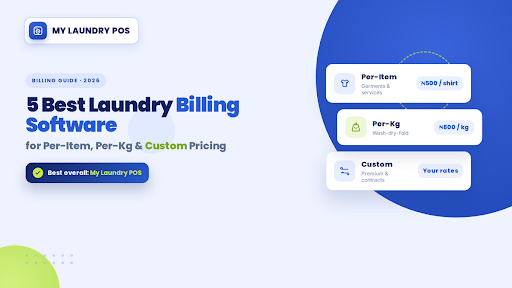
A good laundry billing software allows you to charge per item, per kilogram, or use custom service rates without relying on handwritten calculations. Let’s compare five options and explain which type of laundry business each one suits best.
Why Flexible Billing Matters For Laundry Businesses
Laundry businesses rarely rely on one pricing model. Wash-dry-fold services are often charged by weight, while dry cleaning is typically priced per item. Some commercial customers may also require negotiated rates or recurring invoices.
Managing these models manually creates room for undercharging, inconsistent prices, and customer disputes. A good laundry billing software lets you define your rates in advance and apply them consistently, which helps staff work faster while giving customers clearer invoices. For growing businesses, flexible billing becomes even more important when you add new services, staff, or branches.
Features To Look For In A Laundry Billing Software
It’s better to choose a system that actually supports the pricing methods you use instead of judging it by only the features list. But at the same same look for the following:
- Per-item pricing for garments and individual services.
- Per-kg pricing for wash dry and fold and other weight- based services.
- Custom pricing for premium, specialty, or contract work.
- Fast invoicing that reduces manual calculations.
- Centralized pricing for businesses with multiple branches.
- Payment and receipt support that keeps transactions organized.
- Easy to use workflows that staff can learn quickly.
Best Laundry Billing Software for Flexible Pricing
Here are a couple of options worth considering, with each one of them with it’s unique feature and laundry operating system.
1. Wash-Dry-Fold POS
Overview:
Wash-Dry-Fold POS was built by laundromat owners in the US, and its billing reflects real counter experience. Wash-dry-fold orders are priced by weight from an integrated scale, while commercial clients are set up as accounts, each with its own price level, running balance, and invoice history, so the rate applies itself whenever an attendant rings that customer.
Unique Features:
That account structure is what earns it a place here. Instead of rebuilding invoices from a stack of tickets at month end, you pull a single order or a whole month of them onto one invoice, apply partial payments or overpayments, and charge a card or ACH account kept on file. For laundries whose revenue leans on wash-dry-fold and recurring B2B accounts, that depth is hard to match, though it is worth noting the platform is designed around the US market and its payment ecosystem.
2. LinenTech
Overview:
LinenTech is designed for commercial laundry operations where billing runs far deeper than a standard retail order. It bills by weight, by piece count, or both, and lets you maintain a separate set of prices for every customer, along with different pricing for departments within the same customer organisation.
Unique Features:
This suits businesses juggling negotiated rates and recurring commercial accounts. Because billing is tied directly to production data, its automated invoicing can process an entire month’s invoices in seconds and add extra charges where needed, replacing the spreadsheets and manual calculations that slow larger laundries down. That billing depth fits commercial plants far more naturally than small retail shops.
3. BestatLaundry
Overview:
BestatLaundry is a cloud-based POS built around how UK launderettes and dry cleaners actually operate, and it treats pricing as something you shape rather than accept. You can set products by weight, build custom price lists for different customer segments, and create multiple order types to cover different situations, all from a fully customisable setup.
Unique Features:
Its batch invoicing is the practical draw for busier operators, letting you take payment from several customers at once rather than one at a time. Combined with garment level tracking and custom items, that makes it a strong fit for shops that want flexible, segment specific pricing without moving to a heavyweight commercial system.
4. Enlite POS
Overview:
Enlite POS is a cloud based platform for dry cleaners, laundromats, and alterations shops, and its billing leans into the detail that garment care demands. Pricing can flex by fabric type, garment size, and additional services such as stain removal or alterations, so each order is charged for exactly what it needs rather than a flat rate.
Unique Features:
That flexibility is why it suits service led businesses. Prices can be adjusted easily, and promotions or slow period discounts layered on without disrupting the core rate card, all while barcode tracking keeps each item matched to the right customer and ticket. For dry cleaners whose value sits in specialised, per-service pricing, Enlite handles the nuance well.
5. OnlineInvoices
Overview:
OnlineInvoices is an integrated billing and invoicing tool for laundry and ironing businesses, built around generating professional service invoices and following up with clients. It creates invoices for laundering, dry cleaning, and pressing services, records payments, and lets you switch on only the modules your business actually needs.
Unique Features:
It fits operators whose main need is clean, reliable invoicing rather than a full operational platform. With a free trial and no card required to start, it is an accessible way to move billing off spreadsheets, though shops wanting deep laundry specific workflows will eventually outgrow it.
Which Laundry Billing Software Is Right For Your Business?
Your ideal solution depends on how you charge customers and how complex your operation is.
Before we get to the list, it important to consider customer communication, payment options, staff permissions, reporting, and whether the system can grow with your business. A good billing platform should solve your current problems without creating a new system migration problem later.
- Small laundry shops: If you run a small shop type, then you have to Prioritize simple billing, fast invoicing, and ease of use.
- Multiple service types: When it comes to multi service laundry businesses, it’s best to choose a system supporting both item and weight based pricing.
- Multi-branch businesses: If your laundry has multi branches, then you should look for centralized pricing and reporting.
- Commercial laundries: For commercial laundries prioritize contract pricing and recurring invoicing.
- Delivery focused businesses: If your laundry business is more focused on delivery, always choose software that connects billing with orders and delivery.
How To Combine My Laundry POS With Billing Tools
For many operators, billing does not sit in isolation, it works best when connected to the system that already runs the rest of the business. This is where pairing a dedicated billing tool with a broader platform can make more sense.
My Laundry POS is a cloud based laundry and dry cleaning platform that handles orders, payments, customer records, staff, reporting, and multi branch controls, with pricing and WhatsApp receipts suited to operators in Nigeria and similar markets. On its Enterprise plan it also offers API integrations, which is the practical route to connecting an external billing or accounting tool so invoicing data flows alongside your daily operations rather than living in a separate silo.
The goal when combining tools is to avoid double entry. If you already manage orders and customers in My Laundry POS, a connected billing tool should draw on that same data rather than duplicate it, so an order rung at the counter carries through to the invoice without being retyped. Before committing to any pairing, confirm exactly how the two systems exchange data, since a clean integration saves time while a poor one simply creates more manual work.
Conclusion
Good laundry billing software should make your pricing model easier to manage, not more complicated. Whether you charge by item, weight, or custom rates, the right system can reduce manual errors, speed up checkout, and improve control over revenue.
For businesses looking for flexible billing alongside broader laundry management tools, My Laundry POS is a strong option to consider.